


ALL ABOARD for cutting commuter rail fares within Boston? Not yet.
But the city’s elected officials, who have long pressed for the proposal that they argue is about fixing an unfair distance-based pricing plan that can be expensive for riders and residents, continue to pitch the proposal, even as they face some resistance from the financially strapped MBTA. The elected officials say reducing commuter rail fares would bring a new influx of customers, who in turn would lead to more money in the transit agency’s coffers.
Boston Mayor Michelle Wu called the proposed commuter rail fare cuts “low-hanging fruit that is there to get more people onto reliable public transportation, ease congestion, and help the flow of traffic as we continue to fix the larger system.”
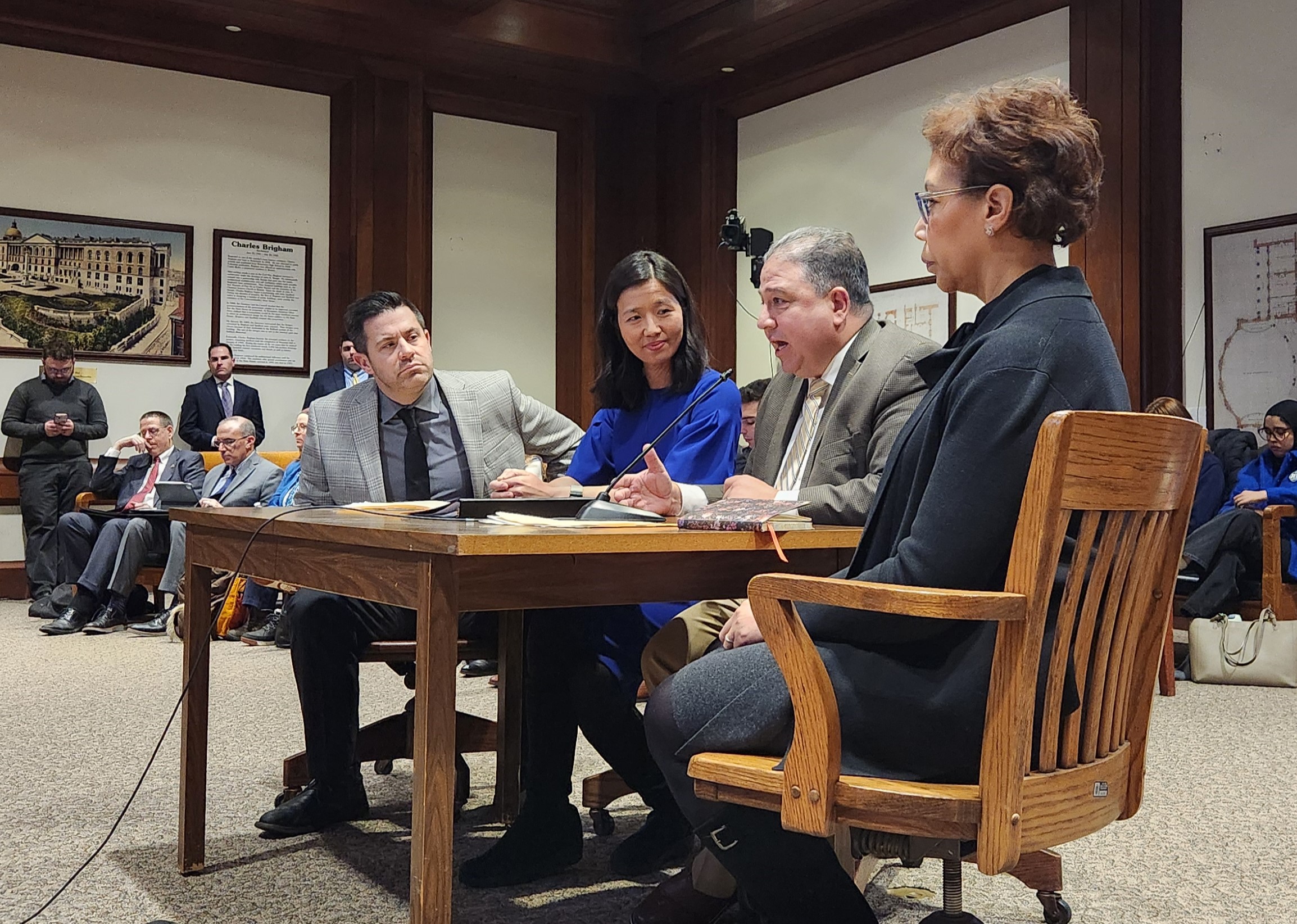
Wu on Wednesday joined three Boston lawmakers and her appointee to the MBTA board of directors, Mary Skelton Roberts, to testify in front of the Legislature’s Transportation Committee, which held a hearing on a bill that would put all of Boston’s neighborhoods within the MBTA commuter rail’s Zone 1A. That means the customers in West Roxbury, Roslindale, and Hyde Park, who currently pay more because their stations are currently outside Zone 1A, would see their fares slashed to $2.40 per ride, or $90 a month, the same cost of the subway.
Riders currently can end up paying $214 a month if they board at Hyde Park Station, $232 a month if they board at Readville, and $90 a month if they board at Fairmount station. The stations are in different zones even though they are a short distance from each other. “It makes absolutely no sense as to why people in Hyde Park have to pay all of these different fares when they’re trying to get to work,” said Rep. Rob Consalvo, who represents the area.
Across the commuter rail system, there are 11 total zones, stretching out to west to Worcester, north to Rockport, Haverhill, Lowell, and Fitchburg, and south to Hanover’s Forge Park, Kingston, Middleborough, and Rhode Island’s Wickford Junction. New Bedford, Fall River, and Taunton will join the system when the full buildout of the South Coast Rail project is completed.
“In the Gateway Cities that help power our region’s economy, fares can range anywhere from 6 to 13 percent of a family’s income, while in wealthier suburbs closer to Boston, fares make up just 2 to 4 percent of a family’s income, which is a distance-based burden that is disproportionate,” Wu said.
Wu, a Roslindale resident and longtime T rider herself, said past discussions about fares with transit officials have had a “very over-simplified, myopic focus on just the number of passengers, tickets that are bought now, and then therefore the dollars that would be lost by multiplying the discount per ticket by the total number of tickets without taking into account the conversions of new people who would be added to the system in adding new fares overall.”
Wu said she and the Boston lawmakers – Consalvo of Hyde Park, Sen. Mike Rush of Boston, and Rep. Bill MacGregor of West Roxbury – often hear from residents who are driving and would switch to taking the commuter rail if fares came down. “It’s a little bit more of a global picture that can be hard to pin down. In some ways we just need to try it and get the data, and find ways to make it happen,” she said.
In a statement Thursday, Phil Eng, the MBTA’s general manager, pointed to the agency setting up a system-wide reduced fare program that would affect tens of thousands of low-income riders. The move will save daily riders up to $750 a year. “This program is a step in the right direction – a monumental moment for communities across the entire state: the first expansion of an income-based safety-net program in Massachusetts since the passage of health care reform,” he said.
As for the fare cut bill that specifically targets Boston, a T spokeswoman said the agency would review any legislation that reaches Gov. Maura Healey’s desk. But T officials remain concerned about setting precedent by changing zones in Boston, as well as the potential impact on revenues of shifting stations between zones.
Reducing financial barriers to public transit “is possibly the most important thing we could be doing for our larger economy right now on an immediate basis,” Wu said, adding that increasing the supply of housing is urgent, but years go by before developers get funding and buildings go up.
“The number one thing I hear from large employers, and from when I’m visiting with various workplaces, is that people don’t feel like the transportation system is reliable enough for them to want to come to work in person,” she said. “We can boost transit ridership and transit revenues overall by adding new riders to the system. There are multiple ways to do that, through better reliability, through increased frequency, and through more affordable fares.”
