


IN MEDIEVAL EUROPE, generations of artisans worked on grand cathedrals like Notre Dame. They knew their work wouldn’t be finished in their lifetimes, but they remained committed to a purpose-driven legacy. From classrooms to courtrooms, as we contend with policy changes and legal setbacks, we need cathedral thinking more than ever.
Uncertainty surrounds us, in the United States and abroad, as public support ushers a shift toward executive-centered governance. Traditional checks and balances like judicial review, due process, and legislative oversight are increasingly considered obstacles and inconveniences—even unreliable. This reflects a longstanding tension between institutional accountability and public expectations, exposing cracks in our democratic foundation.
Some wonder whether democracy may die democratically, but we should avoid the tendency to compartmentalize change into one news or life cycle. Progress isn’t linear or absolute. Sometimes, there’s twisting, even backsliding. The whipsaw may be jarring, but our challenges are deep-seated—even centuries old. Progress is often unfinished.
In the current climate, cathedral thinking compels us to embrace long-term strategies for policymaking and community-building. It shifts our focus from instant results, like winning in court or blocking a bill, to transgenerational change and resiliency.
Even if we can’t see the steeple, we lay stones guided by a clear vision of equal dignity, shared belonging, and thriving futures. Whiplashed by relentless executive orders, cathedral thinking embraces that the scaffolding for progress is “under construction.”
Civil rights history confirms that justice is not a sprint—it’s a relay race. Since social justice work rarely produces immediate wins, we must be comfortable shifting strategies and timelines — and passing the baton.
Brown v. Board of Education and other landmark cases—civil rights cathedrals in their own right—were not conjured in a moment. Progress was layered, textured, and iterative: years of empowering, educating, organizing, litigating, pivoting, and waiting. Stories and interventions add to the palimpsest, with each generation enriching the tapestry of justice. Se hace el camino al andar — the path is made by walking — but sometimes it feels like climbing through rough terrain and inclement weather.
Reimagining our society requires courage, creativity, and patience. Healing past wounds takes time and transcends individual cases or campaigns. Like laying stones to build a cathedral, our collective efforts—legal advocacy, policy reform, community development, and youth engagement—form the bedrock of progress.
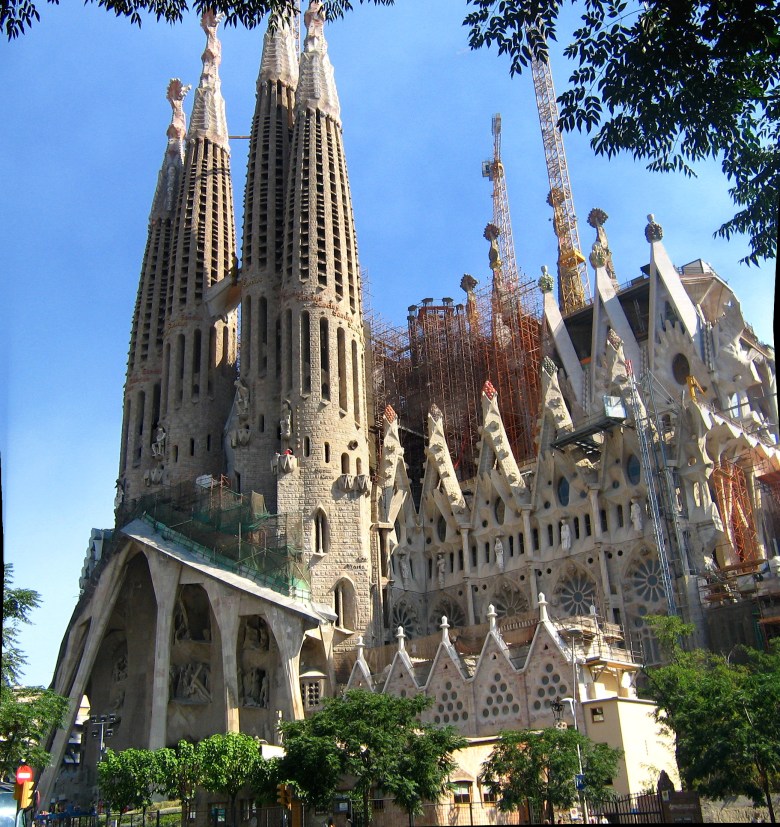
Even today, more than a century after its inception, Barcelona’s Sagrada Família remains under construction—progressing across lifetimes.
In the same spirit, we must embrace justice’s multi-spired and multi-generational nature. We may not win every lawsuit or campaign right now, but that doesn’t make our efforts hopeless. It makes them formative. In the spirit of Rev. Dr. Martin Luther King, Jr., the arc of the universe bends towards justice because people keep pushing.
Our elders know firsthand that the arc doesn’t bend on its own. Change didn’t magically manifest overnight in places like Selma. Crossing that bridge was powerful—it buoyed and imbued hope—but it was only one dimension of a multifaceted civil rights movement.
Unrushed and unhurried, we must think about progress as sustained and durable—not just a spontaneous flash. For lawyers, this means representing one client, knowing it may change countless lives. Each case helps pave the way for breakthroughs and victories. It also means advancing ideas that may not take root until long after we are gone.
Equally important is pipeline development and strategic investment in the next generation. We should cement power-sharing, mentorship, and training into every layer of our work. Advocacy and leadership development should be interwoven if we want justice to withstand erosion.
One person alone can’t build the next cathedral. Justice and progress are collective responsibilities. Cathedrals were built by architects, engineers, masons, and patrons. Today’s struggles require time, talent, and treasure, starting with collaboration among organizers, educators, artists, business leaders, lawyers, policymakers, and donors. Regardless of shape or size, each stone becomes integral to the whole.
How we define and measure success should reflect the value of leveraging long-term strategies. More emphasis should be placed on making the ground fertile for change and planting seeds. Innovation and narrative change are critical to helping progress compound, reshaping institutions, communities, hearts, and minds. That’s why Lawyers for Civil Rights has launched an artist residency, proposed a cultural district in East Boston, and planned a small business incubator—all while filing lawsuit after lawsuit to expand access to justice.
Cathedral thinking is rooted in the belief that we’re part of something larger and unfinished. Echoing the wisdom of various faith traditions: you don’t have to repair the whole world alone, but you should play your part.
The question isn’t, “Will we see it finished?” but rather, “Will we lay our stone with grace and intentionality?” Now is the time to integrate cathedral thinking into our sense-making, policymaking, grantmaking, strategic planning, and program design.
Let’s build the next cathedral, laying stones together.
Ivan Espinoza-Madrigal is executive director of Lawyers for Civil Rights.

CommonWealth Voices is sponsored by The Boston Foundation.
The Boston Foundation is deeply committed to civic leadership, and essential to our work is the exchange of informed opinions. We are proud to partner on a platform that engages such a broad range of demographic and ideological viewpoints.
