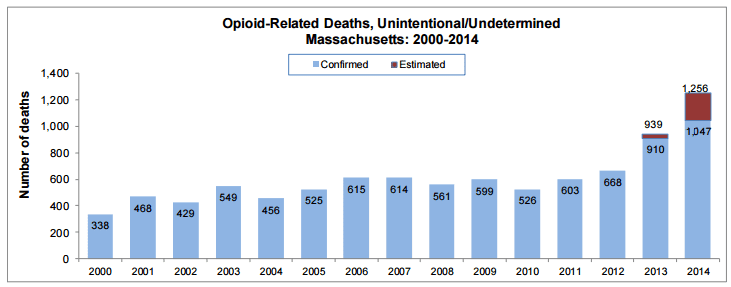
THE STATE’S OPIOID EPIDEMIC is worsening much faster than the Department of Public Health (DPH) said this week in a press release. Over the last two years, there has been an astonishing 88 percent increase in unintentional opioid related deaths, based on new DPH estimates. But the DPH press release said the increase was only 57 percent. Just in the last year, estimated deaths have gone up by a third, twice as high as the DPH release says.
Media outlets around the state snapped up the data as the DPH reported it. DPH spokeswoman Rhonda Mann confirmed the increases described in the press release were erroneous, and said the errors arose due to confusion related to estimated and confirmed deaths.
It often takes a long time for the state’s chief medical examiner to gather information on the cause of a death, so the DPH maintains a hard count of confirmed opioid-related deaths and then uses predictive modeling to “obtain timelier estimates” about how high the death toll will climb. These models are a new development under the Baker administration and are still being refined. The first generation of the model, released in April, generated an estimate of 1,008 total deaths in 2014, which now appears to have been a serious underestimation. As of the August report, 1,047 deaths were confirmed, and the model now estimates 1,256 will be the final tally.
It is the difference between confirmed and estimated deaths where the problem arises. The lower rate of increase reported by the DPH included only the confirmed deaths, though the press release erroneously suggested it included both. The release reads as follows:
DPH analysts had estimated the death count for 2014 to hit 1,008; however, based on an increase in finalized death records, today revised that number to 1,256 – a 57 percent increase in unintentional overdose deaths over 2012, and a 15 percent increase over 2013.
There are enough problems with this construction that rewriting the passage to make it clear is simpler than parsing each one:
DPH estimates published in April suggested the death count for 2014 would hit 1,008. However, based on an increase in finalized death records, DPH has issued a revised estimate of 1,256 unintentional opioid deaths for 2014. If these estimates prove correct, it would represent an 88 percent increase over 2012 and a 34 percent increase over 2013. As of today, a total of 1,047 opioid related deaths have been confirmed for 2014, already a 57 percent increase over confirmed deaths for 2012 and a 15 percent increase over 2013 confirmed deaths.
Mann confirmed that the press release was in error, and that the percent increases referred to the confirmed death toll, and not to the 1,256 confirmed and estimated deaths, as is clearly suggested by the way the release is written. The press release remains unchanged on the home page of the DPH website.
The incorrect percentages were repeated in countless news stories, including reports from the Boston Globe, the Boston Herald, and the State House News. The Associated Press story on the report contained numerous errors.
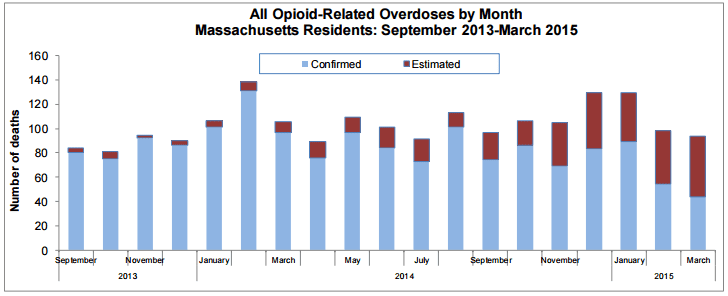
Opioids are a statewide scourge that has clearly gotten way worse over the last few years. While initially anecdotes outpaced numerical evidence, we now have more than enough evidence to demonstrate that we are in the midst of a full-blown epidemic. After staying roughly steady over the last 10 years, opioid-related deaths have skyrocketed in the last two years. In the first three months of this year, little has apparently changed, with deaths on pace to match 2014, if estimates prove roughly on target.
It’s good to know all of this, and good to know all of this right now, instead of two years from now, as was previously the case in Massachusetts when obtaining data on opioid deaths was often difficult. But getting data is only half the battle. The other half is sharing it effectively.

CommonWealth Voices is sponsored by The Boston Foundation.
The Boston Foundation is deeply committed to civic leadership, and essential to our work is the exchange of informed opinions. We are proud to partner on a platform that engages such a broad range of demographic and ideological viewpoints.