


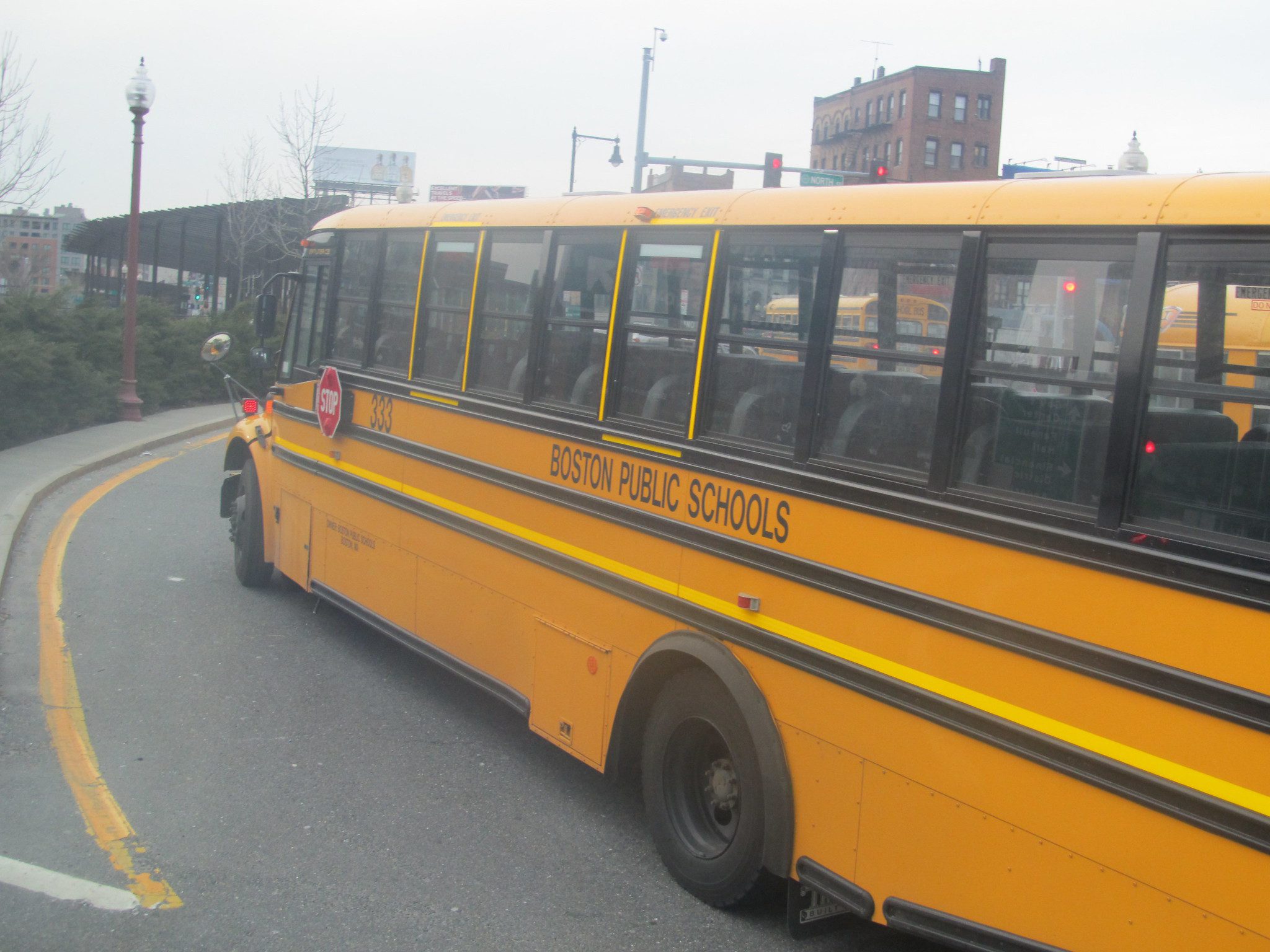
THE FIRST DAYS of school this year in Boston have had little in common with the violence-wracked start to the school year 50 years ago. Except in one respect: The city’s fleet of yellow school buses continue to figure prominently in the headlines.
In 1974, Boston landed in the national, and even international, news with scenes of buses carrying Black students to South Boston High School being pelted with rocks. The violent and vitriolic reaction to the implementation of a federal court order to desegregate the city’s schools marked Boston as the most racist northern US city. Two generations later, the city is still struggling to shed the reputation those days seared into the minds of many.
Last week, the busing problems were of a decidedly more prosaic nature.
After a big build-up of expectations by city leaders that they had smoothed out problems with late arriving buses that often mar the start of the school year, Day 1 of the new and improved bus plan was a bust. Roughly two-thirds of buses were late on the first day, the worst performance in nine years.
Bus performance will undoubtedly get better as drivers settle into their routines, though whether the city will hit the 95 percent on-time benchmark set by a state improvement plan is unclear.
The problem, even once the transportation kinks are worked out of the chaotic start to the year, is that more than 20,000 students will still be spending lots of time every day on buses crisscrossing a densely populated city in search of a quality education. And more than $90 million will be spent by the city to do it.
It’s been years since the city used any type of race-based algorithm to determine school assignments in a district where students of color account for more than 85 percent of the student population. Instead, families must navigate their way through a complicated “choice” system that lets them rank preferred schools within a given geographic area. Schools are classified into four tiers based on a variety of quality metrics, and every family is entitled to have at least one Tier 1 school on the list it chooses from.
With a limited number of Tier 1 schools in the city, families are reluctant to give up the chance the system gives them to land a seat at a higher-rated school – even if the reality means most families won’t get such an assignment.
What it all means, said veteran Dorchester activist Lew Finfer, is Boston hasn’t been able to develop the kind of civic “glue” and sense of community that comes with a school that draws only students from its surrounding neighborhood. “All of that is lost,” said Finfer, who was a young community organizer during the busing years and is cochair of the Boston Desegregation and Busing Initiative, a project established to mark the 50th anniversary of the court order by learning from, and charting a course forward, from the tumultuous busing years of the 1970s.
Finfer is one of many pivotal figures from that period who think Boston needs to look for ways to move beyond a system that undercuts the ability of the city’s schools to play the vital community-building role they assume almost everywhere else.
Ted Landsmark, a Black lawyer and civic planner, gained unwelcomed fame for a 1976 photo that captured him being attacked with a flagpole bearing the American flag at an anti-busing demonstration on City Hall Plaza. But Landsmark has played important policy roles in Boston for decades, including chairing a task force then-Mayor Tom Menio established 20 years ago to consider changes to the school assignment system.
In the end, it came up empty. “The political will was lacking to bring about fundamental change,” said Landsmark, who today serves as director of the Kitty and Michael Dukakis Center for Urban and Regional Policy at Northeastern University.
Another effort a decade later did modify the system and shrink the area from which families make school choices, but the shaky quality of Boston schools has made it politically perilous to propose a system similar to that of other communities, where students are assigned to the local school.
In the 1970s, Landsmark said, “neighborhood schools” were code “for racism.” He said that framing doesn’t apply today, and thinks it’s time to take stock of all the civic benefits that come from them, and have hard conversations about how to get out from a system that remains a vestige of time Boston leaders say they’re eager to move beyond.
“Fifty years later,” Landsmark said, “it’s time for a fundamental reassessment of what we want to accomplish and whether the current system accomplishes that.”

