Election 2026 › Ballot questions
Question 3
All-party primaries
This question asks whether Massachusetts should replace the existing partisan primary election system with a single “all-party primary” in which all candidates appear on the same ballot and the top two vote-getters advance, regardless of their party affiliation, to the November general election.
What your vote means
If this passes
Massachusetts would use a new structure for primary elections starting in 2028 that places all candidates on a single ballot, regardless of party, and advances the top two finishers to the general election.
If this fails
Massachusetts will continue to hold separate Democratic and Republican primary elections. Winners of those contests will face each other in the general election, along with third-party candidates or candidates running under no party label who qualify for the ballot.
The breakdown
Voters will decide whether Massachusetts should embrace a major change in how they elect candidates to county, district, state, and congressional offices.
Today, the Democratic and Republican parties have separate primary elections, each picking a nominee to face off in the general election, where third-party candidates can also appear. The ballot question would replace those separate contests with a single contest in which every candidate whether unenrolled or belonging to a party would appear on the same ballot. The two candidates who earn the most votes would advance to the general election, even if they are both from the same party.
Democrats dominate in Massachusetts, holding every statewide office, every congressional office, and more than three-quarters of state legislative seats. Republican challengers are rare, especially in the state House and Senate, so an all-party primary system could shift the decision about which Democrat should represent a district from the primary to the general election — even if the field comprises only two Democrats.

Supporters say that change will encourage more challengers to enter the field and provide greater competition, even in a state with significant one-party rule. Because more contests will be resolved in the general election, they say, a higher share of voters will be able to offer meaningful input. Yet opponents fear that the system would shut Republicans and third-party or unenrolled candidates out of general elections, giving voters less ideological diversity on their general election ballots.
Four other states have some form of multi-party or nonpartisan primary elections: Alaska, California, Nebraska, and Washington. Louisiana places all candidates on the ballot in its general election, and if no single candidate receives a majority, the top two advance to a runoff.
Effective date
January 1, 2028
What this does NOT change
Municipal elections, which mostly do not involve partisan primaries. Candidates would still need to collect the same number of signatures as before to qualify for the ballot.
How did we get here?
Massachusetts has long had uncompetitive elections. In fact, Ballotpedia has dubbed the Bay State home to the least competitive state legislative races in the country for the last five cycles in a row. This cycle, about three in five House and Senate districts will have a single candidate on the ballot.
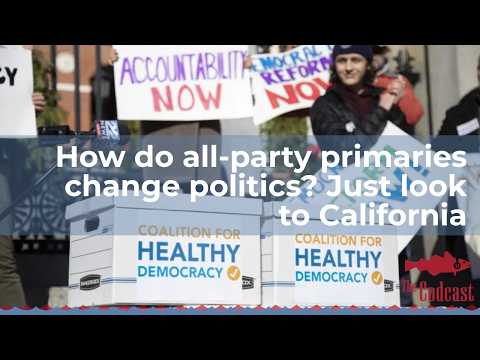
The Coalition for Healthy Democracy, a group founded and led by Harvard University professor and former gubernatorial candidate Danielle Allen, filed the ballot question in an attempt to change the system and its incentives. It’s backed by a constellation of supporters that cuts across the political spectrum, including former Democratic governor Deval Patrick, former MassGOP chair Jennifer Nassour, and the NAACP New England Area Conference.
Opposition is bipartisan, too. Both the state Democratic Party and state Republican Party are opposing the measure, as are progressive transparency activists and several high-profile unions.
Two Democratic state committee members — acting in their own capacity, not on behalf of the party — sued to get the question disqualified. They argued that it would unfairly deprive third-party candidates of a guaranteed path to the general election and limit voters’ ability to pick nonpartisan contenders. But the Supreme Judicial Court ruled in June that the proposal is valid to appear before voters as a “reasonable regulation of elections.”
-
Washington state becomes the first state to run a top-two, all-party primary election.
-
California voters approve state constitutional amendment adopting top-two, all-party primary system.
-
Organizers launch campaign for a top-two, all-party primary system in Massachusetts.
-
Secretary of State’s office announces campaign collected more than 79,000 signatures, making it eligible for the ballot.
-
Supreme Judicial Court rules question is valid to proceed, dismissing lawsuit alleging it violates rights of third-party candidates.
-
CommonWealth Beacon
hosts debate on Question 3 at Northern Essex Community College.
-
Voters decide whether to reshape Massachusetts’s primary election system.
What is each side saying?
 Supporters say
Massachusetts has some of the least competitive elections in the country, and a new system in which two candidates — even if there is no Republican in the race — are guaranteed to advance to the general election will incentivize more candidates to run against incumbents. Because Democrats have such strong control over Massachusetts politics, many races are effectively decided during the lower-turnout primary election. The new system could give voters at least some kind of choice in the general election, even if it’s a contest between two Democrats.
 Opponents say
There's no proven evidence that a top-two primary system increases the number of candidates who choose to run campaigns. The top-two primary system will hurt democratic participation because only two candidates will appear in November, in some cases from the same party, whereas today general election ballots can feature a Democrat, a Republican, and multiple third-party or unenrolled candidates.
Money matters
The charts show the largest contributors to each campaign. Totals combine all donations made by the same donor throughout the campaign and include both monetary and in-kind contributions. Figures are cumulative and reflect overall donor support during the reporting period.
Dive into the data
Related coverage


Videos
Events
Before you vote
 Election Day: November 3, 2026

All ballot questions
THE CODCAST
Where organized labor hits the ballot
All-party primaries