


THE ENERGY DEBATE that is roiling Beacon Hill moved into the Supreme Judicial Court on Thursday as the judges try to decide whether the Baker administration has the legal authority to let electric utilities tap their customers for the money to finance a natural gas pipeline.
The state Department of Public Utilities in October gave electric utilities a green light to purchase natural gas pipeline capacity on behalf of their customers and the agency is now reviewing proposals from Eversource Energy and National Grid to do just that. Attorney General Maura Healey, the Conservation Law Foundation, and ENGIE Gas & LNG appealed to the SJC, saying the agency overstepped its authority.
The dispute, while legal in nature, could have a major impact on the state’s energy debate. Gov. Charlie Baker says the state needs a new natural gas pipeline plus a large amount of hydroelectricity from Canada to keep electricity prices in check, to meet greenhouse gas emission goals, and to maintain the power grid’s reliability. Healey and environmental groups say a new natural gas pipeline will only make Massachusetts more dependent on natural gas for electricity generation and hinder the state’s ability to meet its greenhouse gas emission targets.
The Massachusetts House is also grappling with the issue. House leaders crafting an energy bill have talked about specifically giving the DPU the authority to allow electric utilities to purchase pipeline capacity on behalf of their customers. However, close to 100 House members recently sent a letter to House leaders urging them not to grant the DPU that authority.
The whole issue can be traced to the winter of 2013, when severe cold caused a spike in demand for natural gas to heat homes. The heavy use of natural gas for home heating left many power generators without the fuel they need to produce electricity, which caused prices to spiral upward to historic levels. Ever since that winter, regulators have been trying to come up with ways to ease winter shortages of gas that lead to electricity price spikes.
Many have clamored for new natural gas pipelines into the region, but financing has been a problem. Gas distribution companies want more gas, but not enough to justify a new pipeline. Electricity generating companies would like more gas coming into the region, but they aren’t willing to purchase pipeline capacity in advance without any guarantee they will be able to recoup their money if the weather is warmer than normal and the gas isn’t needed.
The DPU’s novel answer to the problem was to have customers of electric utilities pay for a new natural gas pipeline on the theory that they would ultimately save more money than they spend as plentiful supplies of gas drive down the price of electricity.
The problem is that a 1997 law restructuring law split vertically integrated Massachusetts utilities into two separate industries, one that generates generate electricity and another that delivers that electricity to customers. Eversource and National Grid fall into the latter category.
Healey, the Conservation Law Foundation, and ENGIE say the 1997 law and earlier statutes bar the companies that deliver electricity to customers from getting into the power generation business. They say purchasing natural gas pipeline capacity is crossing the line.
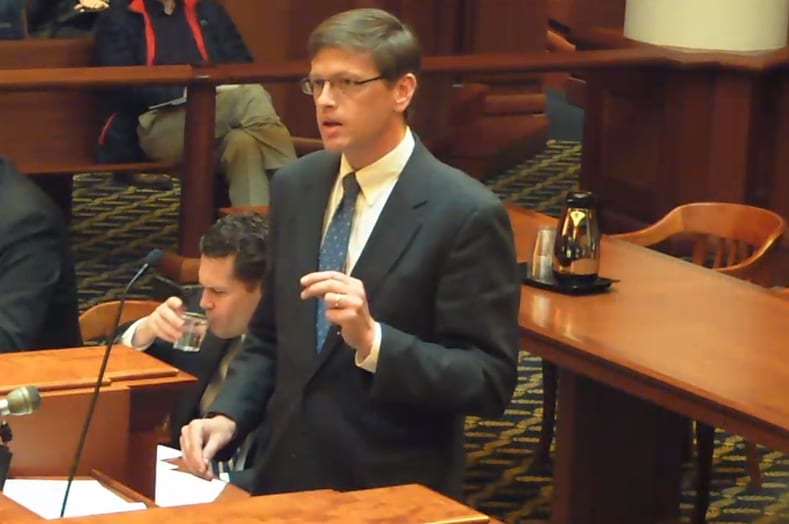
But Thomas Hayman, an attorney representing the DPU, said that Eversource and National Grid, by purchasing natural pipeline capacity, would not be getting into the power generation business; they would just be bringing a fuel into the region.
Hayman also told the judges that they should shoot down the challenge to the DPU’s decision because no contract for pipeline capacity has been approved yet and, as a result, no one has been harmed yet. “It’s premature to choke this idea at this stage,” he said.
But SJC Chief Justice Ralph Gants asked whether the Legislature hadn’t already choked the DPU idea in 1997 with the electricity restructuring law. Gants also said the DPU’s approach seemed to provide a subsidy for natural gas, making the fuel cheaper than its competitor, liquefied natural gas.
David Ismay, the lawyer for the Conservation Law Foundation, insisted that Eversource and National Grid cannot legally tap their customers for natural gas pipeline capacity. Gants sought clarification. “Your view is that even if they are right [that more natural gas would bring down electricity prices], they can’t do it,” queried Gants. Ismay, whose organization believes additional pipeline capacity isn’t needed, balked at the way the question was phrased but agreed with its thrust.
Justice Robert Cordy asked Hayman why the companies that generate electricity don’t pay for the natural gas pipeline capacity. As Hayman struggled with an answer, Justice Margot Botsford jumped in, saying: “Because it’s too risky.”
Overall, the justices seemed skeptical of the DPU’s approach, but there was disagreement on finer points of law. For example, those challenging the DPU said several state laws bar electric distribution utilities from engaging in the power generation business, but they had difficulty pointing to precise language prohibiting the practice.
There was also confusion among the justices about some of the jargon of the electricity business. At one point, Justice Geraldine Hines told the attorney for ENGIE that she understood everything through page 20 of his brief. After that, she said, she was at a loss. “I don’t understand it,” she said. “Could you explain it to an idiot in 10 words or less?”


About 30 years ago New Hampshire’s state legislature passed a law prohibiting Construction Works In Progress (CWIP) charges from being added to the state’s electric bills to finance the Seabrook Nuclear Power Plant. Why isn’t the Massachusetts state legislature passing legislation to prohibit a tariff on electric bills to finance pipelines? Put it on Governor Baker’s desk. If he vetoes it then override the veto. Why should ratepayers finance pipelines and assume all the risks?
Judge Botsford hit the nail on the head. Generators don’t want long-term liabilities associated with fracked methane. Meanwhile, legislators have the power to end this debate by passing legislation prohibiting the DPU from making the bad policy call of letting electric utilities tax us for their fracked methane. And since Governor Baker’s Clean Energy & Climate Plan, released in January, did not mention these pipelines at all, he should just drop it from his combo platter.
“Electricity generating companies would like more gas coming into the region, but they aren’t willing to purchase pipeline capacity in advance without any guarantee they will be able to recoup their money if the weather is warmer than normal and the gas isn’t needed.” – Bingo. So why is it ok to put ratepayers on this hook? This is a whole lot of stupid coming out of the Baker administration. He is throwing his constituency under the bus in favor of big corporations’ profits. Big surprise.