AS LAWSUITS FLY back and forth over President Trump’s executive order changing rules for mail-in ballots, top Massachusetts officials have a simple message for voters: Don’t panic. Nothing is changing yet.
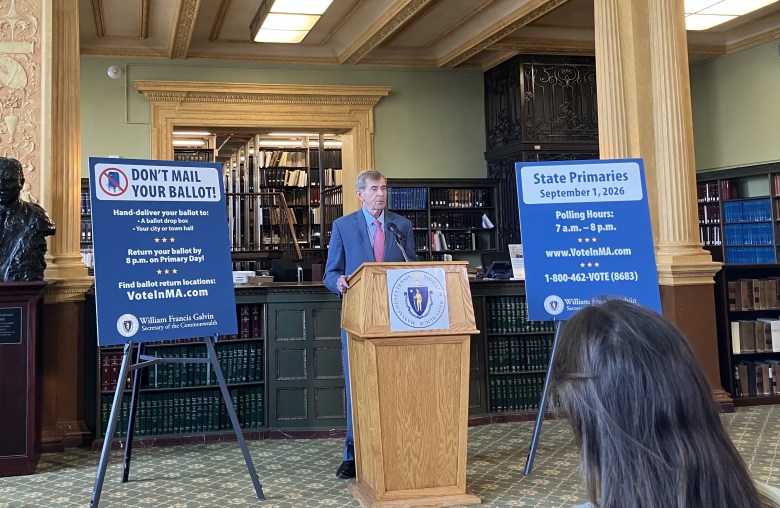
In a press conference Thursday ahead of the September 1 primary, Secretary of State William Galvin said the potential changes cannot and “were never intended to affect the primary” for which mail ballots are already being collected and processed. “The bottom line is the issues before the United States Supreme Court would only affect the general [federal] election.”
That means no impact on state or local races, nor the heated US Senate primary between incumbent Sen. Ed Markey and US Rep. Seth Moulton, nor the crowded Democratic primary to whittle candidates to replace Moulton in Congress.
Trump issued an executive order on March 31 that directed the Department of Homeland Security to compile a state-by-state citizenship list and ordered the US Postal Service to deliver mail ballots only to voters who appear on it. Under the order, states that don’t comply could lose federal funding and their election officials could face criminal prosecution.
Several coalitions sued the administration in early April to block the order — including one comprised of voting rights and civil rights advocates like the ACLU and the League of Women Voters of Massachusetts, and a multi-state group of attorneys general, including Massachusetts Attorney General Andrea Campbell.
These suits argued that the order’s changes would violate the Constitution’s separation of powers, which put the states and Congress in charge of election administration rule, along with laws that govern how USPS operates.
This week, the US Supreme Court dissolved a lower court block on implementing the executive order. The decision split 6-3 along ideological lines, with the conservative justices in the majority. A federal judge in Boston lifted another similar block to align with the high court’s ruling.
The rationale from the Supreme Court turned on the lawsuits being filed before the postal service rolled out its new rule purporting to grant USPS the authority to regulate mail voting in elections. The states could not sue, the high court said, because they challenged the executive order before federal agencies finalized the policies.
White House spokeswoman Lauren Bis called the Supreme Court ruling “a major win for the security of American elections.”
Campbell’s office and Galvin noted that USPS released its rule the Friday before the court lifted the block. Neither the Supreme Court nor the later lower court ruling decided on the policy’s legality.
“Today’s decision creates unnecessary confusion as the November election approaches,” Campbell said after the court ruling.
The finalized 95-page rule would create a new USPS portal, where election officials would have to submit each mail-in voter’s name and address, as well as unique Intelligent Mail barcodes on the outbound and return ballots. It would also require election officials to submit ballot-envelope designs to USPS for review.
Postal service employees would need to check every mail ballot against the portal, returning mailings that are not verified to election officials, who would then need to correct and resubmit them.
The postal service “will not play any role in determining voter eligibility, maintaining voter rolls, or counting ballots,” according to the rule. It “will not open ballot mail, including Federal Ballot Mail; will not know the contents of a ballot; will not know how an individual voted; and will not know an individual’s political party affiliation.”
Both coalitions suing doubled down after the blocks were lifted, with the attorneys general launching a new lawsuit on Wednesday challenging the new rule.
“Mail-in voting is safe, secure, and relied on by millions of voters, including the president himself,” Campbell said in a statement. “States have the constitutional authority to administer elections, not the president or the Postal Service. We’re asking the court to immediately block this unlawful rule and protect the integrity of mail-in voting and the more than one million eligible Massachusetts voters who rely on this system.”
The ACLU coalition filed a supplement to its complaint on Wednesday, also asking the federal court to halt implementation of the newly finalized mail ballot rule.
“USPS’s decision to rush this blatantly unconstitutional rule into effect just weeks before an election is the latest step in a rollout that has sown confusion at every turn and now threatens to disenfranchise voters who did everything right. This is chaos by design, and voters are the ones who will pay for it,” said Sophia Lin Lakin, director of the ACLU’s Voting Rights Project, in a statement.
These cases are scheduled for a hearing next week, Galvin said.
Galvin expressed confidence on Thursday that the rule could not and would not be implemented.
“It would be impossible to try to put this order into effect in the period of time that’s left between now and the general election,” he said. “It would be bad policy at any time, but impractical completely to try to do it at this time, and it will not be able to happen.”
Vote-by-mail has been widely adopted in Massachusetts since the option was introduced six years ago amid the Covid pandemic. More than 520,000 voters cast mail-in ballots in the 2024 primaries.
As September draws near and November looms, Galvin said he doesn’t think voters need to make alternative plans for mail voting.
“I’m not saying that because I’m absolutely confident the court won’t do anything,” he said. “But I’m telling you right now, we’re going to be doing anything we can” to make the voting process in November as smooth as possible.
“We’ll find creative ways” to adapt, he said. Likely adjustments could be expanding early in-person voting or extending voting hours, he said.
“Remember, all of these efforts that Trump is making are based on delivery of the ballot methods,” he said. “We may find other ways to deliver,” he said, offering a wry “maybe I’ll have drones.”